



















Key takeaways for caregivers
- Attachment security, or how safe and supported an infant feels with their caregiver, develops from the way caregivers communicate, both during challenging moments (e.g. separations, reunions) and in low-stress situations (e.g. everyday playtime).
- Mothers who accurately notice and comment on their baby’s feelings during typical, low-stress situations exhibit mind-mindedness, which helps infants feel understood and supports secure attachment.
- Mind-mindedness during everyday play predicts higher levels of infant comfort during times of stress, a key factor in fostering secure attachment.
This piece was written by Ishani Bharadwaj in collaboration with study author Elisabetta Lombardi. It is based on research originally published in Lombardi, E., Di Dio, C., Meins, E., Giovanelli, C., Crippa, F., Traficante, D., Marchetti, A., & Carli, L. L. (2024). Inter-relations between mind-mindedness, maternal communicative style in the context of attachment distress, and infant-mother attachment security.International Journal of Behavioral Development, 49(3), 288-298.
What is secure attachment?
Babies enter the world fully reliant on their caregivers for survival. They create their first social bonds, or attachment relationships, with those caregivers, typically their parents. Caregivers provide essential care, soothe them, and respond to their physical needs (e.g., hunger, safety, comfort).
Attachment security describes how safe and secure an infant feels with their caregiver. Beyond fulfilling basic needs, these attachment bonds serve as an infant’s initial guide for understanding relationships, including how to anticipate others’ behaviors and share emotions. Consequently, early attachment experiences can significantly shape how infants navigate social relationships as they grow.
When caregivers consistently meet infants’ needs and offer care during distress, infants are more likely to cultivate a secure, positive view of the world—perceiving it as safe and predictable, and believing they are deserving of care.
On the other hand, when needs are disregarded or caregivers are unresponsive, infants may grow to view the world as untrustworthy, leading to challenges in forming social connections in the future.
Communicative style: How caregivers respond to their infants in moments of stress
The way caregivers communicate with and respond to their infants, especially in stressful situations, plays a crucial role in developing secure attachment.
Caregivers reflect their style in high-stress moments. When a baby cries, a caregiver may choose to provide emotional support and comfort or deny support, confusing the infant about the stressful situation. Infants whose caregivers express warmth and support tend to develop greater attachment security compared to those whose caregivers do not.
Mind-mindedness: Caregivers’ attunement to their infant in low-stress situations
Mind-mindedness refers to the caregiver’s ability to recognize and accurately respond to the child’s internal states, including emotions, desires, and thoughts, even in everyday low-stress scenarios.
Effective mind-mindedness occurs when a caregiver’s comments align with the child’s behavior, translating observations—such as facial expressions or changes in emotional tone—into words.
Mind-mindedness captures the caregiver’s ability to remain closely connected to the child’s experiences, even before the child can articulate them verbally.
A mind-minded caregiver is sensitive to the child’s signals, responding in ways that validate their experiences. This ability fosters a closer connection, ensuring that emotional experiences don’t go unnoticed.
An example of a mind-minded response
Consider a one-year-old playing with a toy. If the toy slips from their grasp, causing distress, an attuned mother moves closer, locks eyes, and gently states, “Oh, that surprised you! You seem frustrated that the toy fell. Let’s get it back so you can keep playing.” This mother responds in a reassuring manner, reinforcing her child’s feelings.
Through her comments, she exemplifies mind-mindedness by accurately interpreting and affirming her infant’s emotional state.
An example of a non-mind-minded response
In contrast, non-attuned or non-mind-minded responses can misinterpret or minimize the child’s emotional experience. Imagine the same mother, responding dismissively: “Oops! That’s nothing—look over here!” While she may recognize her infant is upset, she fails to connect with those feelings. This response deflects the child’s distress instead of acknowledging it.
Our study: Examining the role of mothers’ mind-mindedness in babies’ secure attachment
Extensive research highlights the significance of a mother’s communication style during high-stress situations in an infant’s attachment security. In our study, we focused on the role of mothers’ mind-mindedness during low-stress conditions to explore how it influences attachment security.
Conducted in Milan, Italy, the study involved 88 native-born mothers and their 12-month-old infants. All mothers were between 26 and 45 years old, typically living with spouses, with many being highly educated.
While this group shared common characteristics, the findings may not universally represent all families, as dynamics can vary significantly across different cultural backgrounds and family structures.
The Strange Situation Procedure
To assess infant-caregiver attachment security, we utilized the well-established Strange Situation Procedure, observing each child during a series of brief (three-minute) separations and reunions in a comfortable lab setting.
During this process, we aimed to understand infants’ reactions upon reuniting with their mothers. Did they exhibit difficulty calming down? Did they seek comfort or shy away from their mothers?
Mind-mindedness in a free-play setting
To examine mothers’ mind-mindedness, we spent 25 minutes observing mother-child interactions in their homes. This setting allowed us to see how mothers responded during low-stress playtime.
We observed mothers’ mind-related comments—verbal cues that effectively reflected their child’s inner thoughts or feelings. Examples included labeling emotions (e.g. “You’re frustrated”) or expressing thoughts from the infant’s perspective (“I’m scared”).
Comments were categorized as appropriate when they aligned with the child’s observable state. We coded and analyzed the proportion of maternal responses that were appropriately attuned versus those that were non-attuned.
Goal 1: Confirming links between mothers’ communicative styles and infants’ attachment security
Our findings confirmed the established connections between supportive communication from mothers and secure attachment in infants. When caregivers offered emotional support—understanding and affirming their child’s feelings—infants were more likely to display secure attachment behaviors.
In cases where mothers misinterpreted their child’s emotions or employed confusing communication, infants were often less secure, appearing hesitant or indifferent during reunions.
Goal 2: Mind-mindedness during play was also related to attachment security during reunions
Our research also revealed a clear relationship between effective mind-mindedness and attachment security. Mothers demonstrating strong mind-mindedness during low-stress interactions provided equivalent levels of emotional support during stressful situations.
Those who practice mind-mindedness tend to nurture children who are securely attached.
These patterns underscore the vital link between how mothers engage in everyday situations and the attachment security experienced by their children during higher-stress instances.

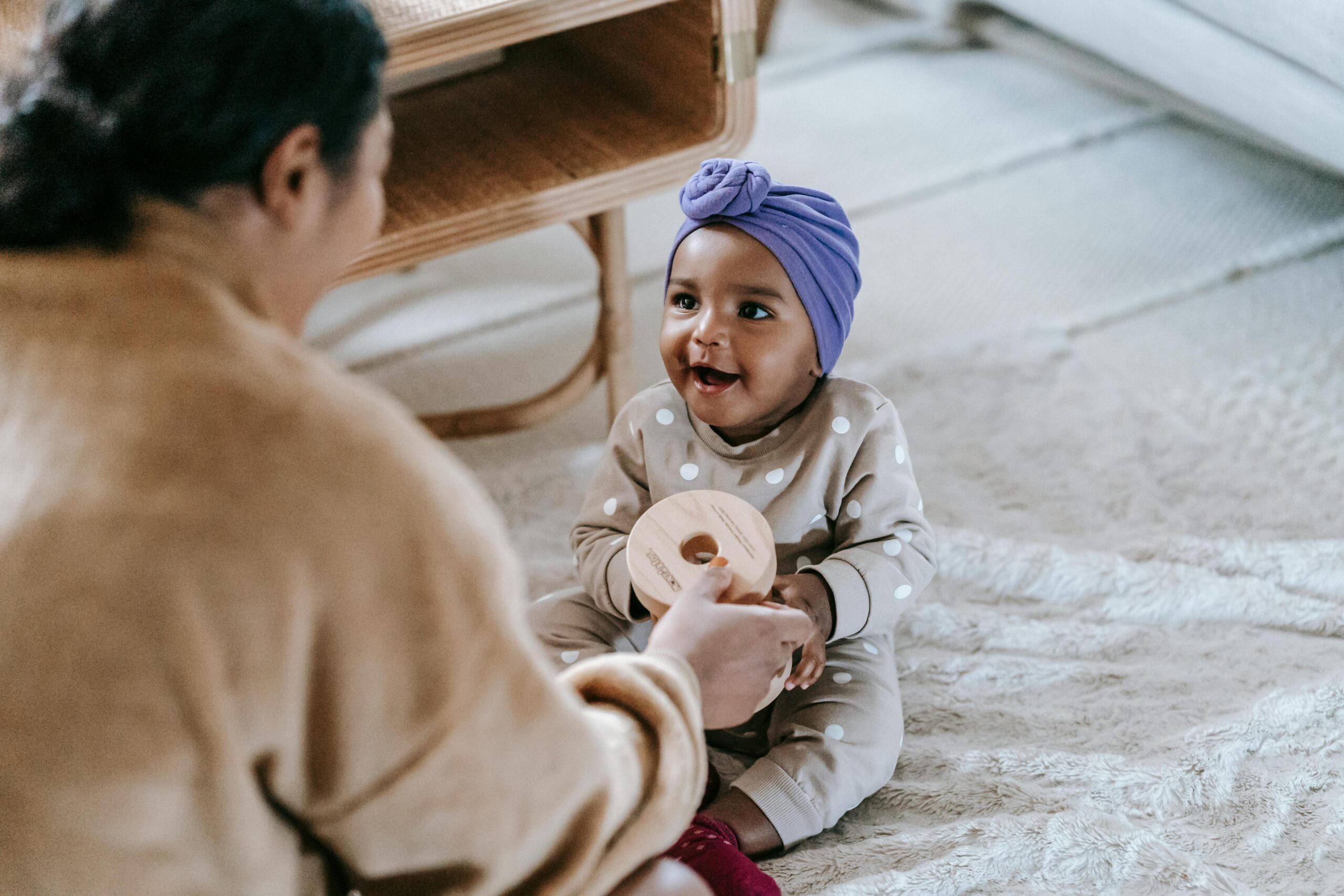
Photo by Polesie Toys on Pexels
Mothers’ mind-mindedness strengthens the link between mothers’ emotional support and infants’ secure attachment
The aspect of mind-mindedness most closely linked to the effectiveness of mothers’ emotional support was the ability to accurately interpret and comment on mental states. This indicates that emotional support contributes to secure attachment not only on its own but is even more effective when mothers can also think about their child’s feelings and accurately convey them.
Raising securely attached infants: Practical implications for caregivers
To nurture secure attachment in a child, it’s essential to provide comfort during challenging moments while embodying mind-mindedness during everyday interactions. Infants are more likely to develop secure bonds when caregivers validate their feelings and demonstrate an understanding of their mental states.
Here are practical steps caregivers can implement:
- Acknowledge all their child’s emotions: Recognize and respond to a child’s emotional expressions, including more challenging ones like frustration or fear.
- Name the emotions aloud: Help the child grasp their feelings by verbalizing them (e.g., “You seem upset because the block toppled over”).
- Avoid misleading or dismissive responses: Steer clear of sending confusing signals, such as offering cheerful distractions when the child is clearly upset, which may hinder their ability to understand and recognize their emotions.
- Support their child in calming down: Provide comfort and techniques to help them regulate their emotions (e.g., practicing deep breathing together, offering a hug, or assisting with problem-solving).